H-1B immigration status is designated for individuals coming temporarily to the U.S. to perform services in a specialty occupation. Sponsoring an H-1B employee is the most common way to bring an international employee to WashU.
Contact OISS if the employee is from one of the following countries:
| Australia | E-3 Employee |
| Canada | TN Employee |
| Chile | H1B1 Employee |
| Mexico | TN Employee |
| Singapore | H1B1 Employee |
A specialty occupation is defined as an occupation which requires theoretical and practical application of a body of highly specialized knowledge and attainment of a bachelor’s or higher degree for the specific specialization (or its equivalent in experience).
Employers bear a certain liability when filing H-1B petitions based on the U.S. Department of Labor (DOL) guidelines. Employers must make attestations about the wages for H-1B positions and guarantee the return fare home if they terminate an H-1B’s employment before the end of the period of authorized stay. Violation of these requirements may lead to fines for WashU and stopping WashU from filing H-1B petitions.
On this page
WashU sponsorship of H-1B
Departments considering requesting an H-1B for an employee should contact the Office for International Students and Scholars (OISS) before making a commitment of H-1B sponsorship. The decision about H-1B sponsorship is based on several factors:
- Business needs of the department
- H-1B regulations about qualifying positions
- Prospective employee’s previous visa history
- Prospective employee’s educational credentials
Certain visa types are not eligible to change status to H-1B. Those types of immigration statuses include:
- Visitors who entered under the visa waiver program (WB or WT)
- J Exchange Visitors subject to the Two-Year Home Residence Requirement of section 212(e)
- Foreign nationals currently in the United States in violation of their immigration status
- And others, where a change of status is prohibited
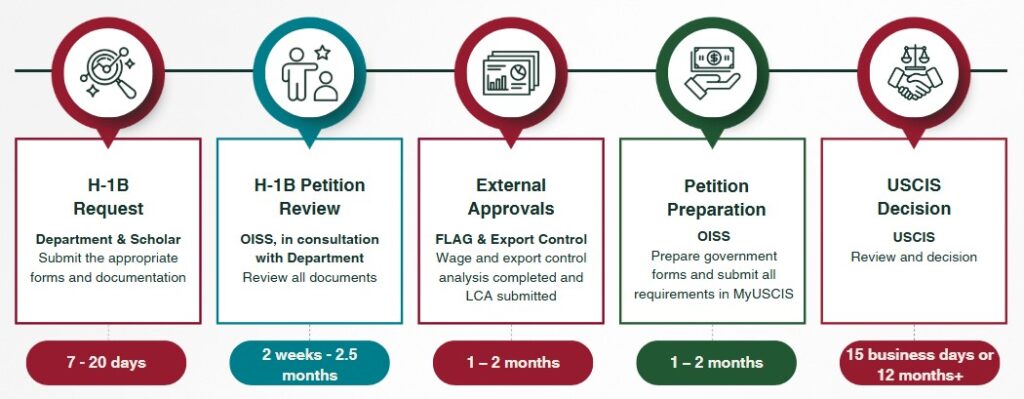
Overview of process
Application fees
As of November 1, 2025 employers must pay all fees for H-1B petitions electronically and directly to the government. OISS will submit this information on your behalf when submitting the petition. The following fees will be then be charged to your cost center through an Internal Service Delivery (ISD):
- Electronic payment fee $250
- H-1B petition fee $460
- Fraud prevention fee $500 – when applicable
- Premium processing fee $2,965 – required if requesting USCIS premium processing (see Step 4 for processing timelines)
Postdoc titles and clinical positions
To qualify for H-1B sponsorship by WashU, the position must be an employee position. WashU will not sponsor an H-1B for the Postdoctoral Research Scholar or Research Fellow (non-employee, stipend recipient) title. Only individuals appointed as Postdoctoral Research Associates (employee title) qualify for H-1B status.
H-1B application process
For applicants living outside of the U.S. or those currently in the U.S. on a different immigration status. Note that this process has changed as of December 2025.
A sponsoring WashU department must initiate the application
OISS processing time for H-1B scholar applications is approximately 2-3 months. USCIS processing times vary greatly without the use of premium processing.
OISS will also have to submit an H-1B petition for employees who are transferring or porting their employment to WashU. If you are hiring a prospective employee who is currently in H-1B immigration status, contact OISS for next steps.
Step 1: Complete New H-1B Request
Submit the New H-1B Request (below) to initiate the scholar intake with OISS. OISS must receive this form in order to begin processing a case.
- You can submit the request as soon as the department makes an offer of employment to a qualified foreign national for an H-1B eligible position. The offer should note that it is contingent upon the employee obtaining the appropriate immigration status and employment authorization.
- We recommend submitting the full H-1B application to OISS at least three (3) months and no more than eight (8) months in advance of the requested H-1B start date.
Step 2: Employee
When OISS receives the H-1B Request, we will send an email to the scholar from oiss-scholar@wustl.edu to begin the intake process.
Employee/scholar: Complete the steps detailed on the H-1B Employee Intake Instructions webpage. The first step is to complete the required WashU H-1B Orientation course in Homebase.
Step 2: Department
When OISS receives the H-1B Request, we will initiate the department intake process, and the department contact will be asked to complete departmental intake forms.*
Department contact: Complete the steps detailed on the H-1B Department Intake Instructions webpage.
*If the WashU department is requesting an H-1B for the first time, contact the Associate Director for Scholars for an introduction and a brief orientation of the process.
Department: submit H-1B documents to OISS in a timely manner
The new H-1B request forms are in Box folder “00 Department H-1B Resources.” There are three subfolders in your specific departmental folder:
- New H-1B Requests
- H-1B Cases Assigned to OISS Advisor
- H-1B Cases Submitted to USCIS
When you are ready to upload paperwork, create a subfolder inside the department folder. Use the following format for every new folder you create: “LASTNAMEFirstname_DOB (MMDDYYYY).” Upload all request forms and supporting documents into the scholar’s specific named folder.
If you are a returning department and you have trouble downloading any files, contact OISS.
When the subfolder includes the following completed documents, it will be assigned to an OISS adviser.
- H-1B Department Request Forms
- Deemed Export Questionnaire
- LCA Attestation form
Step 3: OISS reviews and submits LCA
Average of 1-2 months
OISS receives the paperwork, checks it for accuracy and completeness, and verifies that both the employee and the job qualify for H-1B status. We will inform the department of any issues and missing documentation. Immigration regulations then require that we create a public access file.
OISS sends the deemed export information to the Office of the Vice Chancellor for Research for review.
OISS determines the prevailing wage for the position and files a Labor Condition Application (LCA) with the Department of Labor (DOL) up to six (6) months before the requested H-1B start date.
The DOL returns the LCA to OISS to include in the H-1B petition. The Office of the Vice Chancellor for Research sends the deemed export recommendation to OISS.
Step 4: OISS submits to USCIS for approval
USCIS premium processing time for a response (not always a decision) is 15 business days
USCIS regular processing time for a response is 5-12+ months
It is important to know that USCIS processing times can vary greatly without the use of premium processing. Accordingly, all change of status and consular processing H-1B cases must be filed via the premium processing service. For other H-1B cases, we are recommending that hiring departments and PIs budget and include premium processing for the request.
In light of recent and upcoming regulatory changes, H-1B petitions filed under regular processing may face significant delays, a higher likelihood of requests for evidence (RFEs) from the government related to wage levels, and in some cases could be placed on hold indefinitely.
Once the H-1B petition is complete and OISS has reviewed and shipped it to U.S. Citizenship and Immigration Services (USCIS), the scholar’s subfolder will move to “H-1B Cases Submitted to USCIS”.
- OISS submits the I-129 petition and supporting evidence to USCIS.
- USCIS approves, sends a request for evidence (RFE), or denies the H‑1B petition. USCIS sends notice of the decision to OISS.
- If we receive an RFE, OISS contacts the department and/or employee for the documentation needed. We respond to the USCIS RFE.
- Once approved, OISS notifies the employee when the approval notice is ready for pick up.
Upon submission to USCIS, the H-1B fees will be charged to your cost center through an Internal Service Delivery (ISD), as submitted on the New H-1B Request.
The employee can begin working at WashU according to the terms of the petition filed and the approval notice issued by USCIS. Or, if the employee is outside of the U.S., they can apply for an H-1B visa from the Department of State (DOS) to enter the U.S. and begin H-1B employment.
Amendments and extensions
For applicants currently in H-1B immigration status, needing a change or an extension of their status, contact OISS to determine whether a new H-1B application to USCIS is necessary. If so, the process will mirror that of an initial H-1B application.
| Amendment | Changing employment such as title, site of activity, job description, salary, or hours worked |
| Change of employer | Transferring (porting) to WashU from another institution |
| Extension | Extending employment end date (details remain the same) |
Extensions beyond six years
Generally, H-1B status can be held for a total of six (6) years, applied for in increments of up to three (3) years. However, extensions beyond the six (6) years are possible in some circumstances. If an employee believes they are eligible and the hiring department wishes to pursue an extension, the hiring department should contact OISS.
Only time spent physically present in the U.S. in H-1B status is counted toward the maximum H1-B period. Days spent outside the U.S. can be “recaptured” and added back to the employee’s total maximum period of stay, provided those absences are properly documented.
To properly document time spent outside of the U.S., we encourage H-1B employees to keep a detailed record of all travel abroad along with all related immigration documents. The evidence of travel is the employee’s I-94 records. USCIS may accept the following documents as supplemental evidence: boarding passes, airline tickets, frequent flyer records, travel itineraries, credit card statements with travel purchases and hotel receipts.
An H-1B employee may qualify for an extension of H-1B status beyond the six (6) years based on a pending lawful permanent residence (LPR) application: 365 days or more have passed since the filing of a labor certification (also known as the 365-day rule) or I-140 petition if a labor certification is not required, or the employee is the beneficiary of an approved I-140 petition and is not able to file to adjust status to U.S. LPR due to country visa limitations. OISS will need to review any I-140/I-485 receipt and/or approval notices, to determine if the employee is eligible for an extension.
In general, OISS recommends departments continue to extend H-1B status (when possible) until LPR status is approved, rather than the employee working on a pending adjustment of status EAD.
If you are interested in sponsoring an LPR application for an H-1B employee, discuss options with the Associate Director for Scholar Services no later than the beginning of the employee’s third year of H-1B status.
If the employee has been physically absent from the U.S. for at least twelve consecutive months, they may be eligible for another six years of H-1B status. Documentation of time spent outside the U.S. is necessary to apply for the additional period of H-1B status; this may include proof of employment outside the U.S., copies of lease agreements, etc.