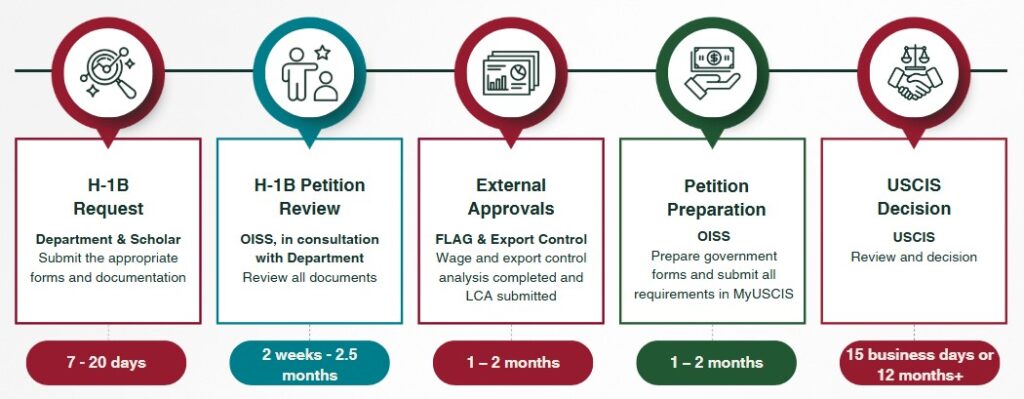
This page is for WashU departments who want to sponsor an employee in H-1B status and are completing the H-1B Department Intake Request. We will guide you through the steps needed to complete and submit the request and the necessary intake forms. Review this page thoroughly before submitting the Intake Request. This will help reduce errors and streamline the application preparation process.
The department contact, the employee’s direct supervisor or the principal investigator (PI), the department chair/program director, and other administrative staff need to complete the intake forms.
Step 1: Docketwise request
After OISS has received and processed the New H-1B Request, you will receive an invitation to Docketwise. This is the OISS system for processing H-1B applications. The email will come from no-reply@notifications.docketwise.com.
Receiving this email indicates that OISS is ready for you to submit the intake forms. You do not need to open the Docketwise request until the intake forms are completed and ready for submission.
Step 2: PDF intake forms
Navigate to Box to download blank versions of the required PDF forms.
Note
You will not submit any forms in Box. Box is only used to store form templates. Submit complete forms to OISS through Docketwise.
You must submit four separate documents in Docketwise. Three of the four documents are forms you will need to download from Box. We recommend bookmarking each form template. Please use the bookmarked template every time you need to fill out the form for a new case.
- H-1B Department Information Form
- H-1B Labor Condition Application Attestation Form
- Export Control Questionnaire
NEW required document required in Docketwise:
- Offer letter
These forms have changed. Make sure to use and bookmark the new versions linked here.
Step 3: H-1B Department Information Form
Some information within this form is completed by the department contact or HR. Other information must come directly from the supervisor or the principal investigator. See specific sections outlined below for details and clarification on specific questions asked on the form.
When saving this form, be sure to use the employee’s first and last name in the file title.
Position information
To be completed by the department contact.
Question 2: For postdoctoral positions, postdoctoral training is limited to 5 years, which includes postdoctoral time at other institutions. If the beneficiary needs time beyond the 5-year maximum, you must apply for an extension through the Office for Postdoctoral Affairs.
H-1B prevailing wage determination
To be completed by the department contact in consultation with the department’s Business Manager or HR Representative.
Information in this section must be based on the criteria for the role in general. It should not be based on the beneficiary’s qualifications. Beneficiaries will submit their information through the Scholar Intake Process.
- Question 6: Acceptable degree(s) field of study
- In addition to the common fields of study, this field should include the degree held by the beneficiary as well as other employees holding the position
- Examples of fields of study include but are not limited to: Cell Biology, Microbiology, Bioengineering, Environmental Science, Computer Science, Nanotechnology, Physics, Biomedical Science, Immunology, Genetics, Pharmacology
- Question 10: Travel outside the St. Louis area
- This question refers to regular travel obligations, not one-time travel events such as conferences or lectures.
- Question 12: Affiliate locations
H-1B actual wage
To be completed by the department contact in consultation with the department’s Business Manager or HR Representative.
Question 14: Physicians in H-1B status cannot moonlight for other departments or locations not listed in the H-1B petition.
Job description
Must be provided by the direct supervisor or the principal investigator.
Question 18: All three parts of this question are critical to the H-1B petition preparation process. See sample responses below as you provide your response.
Sample 1:
My laboratory investigates the role that immune cells and molecules play in central nervous system, especially brain (dis)function and exploring the mechanism of neuroimmune interactions associated with some neurological disorders and CNS trauma. The type of research conducted in the lab is fundamental research. Completion of these studies will increase our fundamental knowledge of human neurological diseases such as Alzheimer’s disease, Parkinson’s disease, multiple sclerosis, spinal cord injury and other CNS trauma. Furthermore, this research will enable therapeutic targeting of the immune system and develop novel neuroprotective therapies.
Sample 2:
My laboratory investigates molecular mechanisms associated with development, differentiation, metabolism and function of bone and cartilage cells, namely, osteoblast, osteoclast, and chondrocytes, and their response to inflammatory conditions. We mainly focus on the role of transcriptional regulation (ie NF-kB signaling) in these cells under chronic inflammatory conditions including osteoarthritis, rheumatoid arthritis, inflammatory bowel diseases etc. The ultimate goal of these studies is to develop therapies at the signal transduction level to combat and eradicate these skeletal diseases.
Sample 3:
My laboratory focuses on understanding how tissue growth and tissue organization are
coordinately regulated during normal development, and how loss of this control leads to human disease. We are currently researching a highly conserved, but poorly understood, Nuclear Envelope Membrane Protein (“Nempl”), utilizing primary and immortalized cell lines and mouse models to understand the function of Nempl. Understanding the precise function of Nempl should provide a means to understand fundamental roles of nuclear envelope proteins in fertility. This work has the potential to illuminate treatment of some causes of infertility.
Sample 4:
The Department explores the complexity and richness of human experience as expressed in the languages, histories, cultures, and literatures of China, Japan, and Korea. Not only are the civilizations of East Asia among the world’s most ancient, these three cultural and linguistic areas have also come to play a vital role in today’s global economy. The Department offers a wide-ranging and diverse curriculum by means of which students may acquire knowledge and understanding of the literary, historical and cultural expressions of East Asia from ancient times up to the present.
Our language programs also foster the ability to negotiate meaning in a culturally and contextually appropriate manner through the development of high levels of proficiency in speaking, listening, reading, and writing. The emphasis in the East Asian Language and Culture programs (with concentrations on Chinese, Japanese or Korean), is on achieving high competency in the relevant language and learning how to read texts from the target culture—literary, philosophical, cultural, historical, or even visual—with an informed appreciation of the contexts in which they were produced.
Sample 1:
Primary responsibilities include research, teaching, and service responsibilities. Teaching
duties will be assigned by the Chair of the Department. The Beneficiary will be expected to teach standard courses per year and conduct a program of research and writing for publication. In addition, the Beneficiary will be expected to carry out regular service and committee assignments (at the department, school, and/or university level) as well as student advising throughout the year. Specifically, the Beneficiary will engage with graduate and undergraduate students in formal classes in anthropology and anthropological archaeology, in individual and group meetings, and, as appropriate, in lab settings. In addition, the Beneficiary will teach classes on geoarchaeology, the archaeology of ancient Europe, Public Archaeology, Microarchaeology, and Advanced Micromorphology. The Beneficiary will utilize lab methods, including micromorphology, geochemistry, stratigraphy, soil analysis, and phytolith analysis.
Sample 2:
The Beneficiary will independently develop and conduct research projects, including designing research protocols as well as developing, improving, analyzing and troubleshooting procedures for the collection, verification and management of experiment results. The Beneficiary will provide supervision, mentorship, and training in advanced research techniques to researchers in the lab; participate in research collaborations with other WashU investigators; and solve practical problems with equipment and routine maintenance of equipment. To conduct their research, the Beneficiary will use advanced techniques in various areas, including cell biology, molecular biology, immunology or neuroscience with wet-bench skills in microscopy imaging, flow cytometry and/or mouse behavioral science.
Sample 3:
The Beneficiary will investigate the molecular mechanisms underlying bone loss associated with chronic inflammation. The Beneficiary will use in vitro and in vivo mouse models and genetic approaches to study signaling pathways in osteoclasts and their progenitors. The goal of this project is to decipher the cellular and molecular mechanisms underpinning IFN-stimulated genes (ISG) that regulate functions of osteoclasts and immune cells. These studies will shed light on musculoskeletal diseases associated with inflammatory osteolysis.
Specifically, the Beneficiary will utilize animal models (breeding and maintaining various genetic models, fracture generation); mammalian cell cultures (macrophages, osteoblast, osteoclast, osteocytes); and various molecular techniques including molecular cloning, qPCR, cDNA library, site directed mutagenesis, RNA sequencing, ELISA, FACS. They will analyze stem cells, complete pharmacological training in rodents, structural and histological analysis of bone specimens, immunohistochemistry, and micro computed tomography (uCT). In addition, the Beneficiary will be responsible for planning and executing experiments and participating in scientific discussions; presenting scientific data at regional, national, and international meetings and conferences; and maintaining comprehensive lab records according to the established procedures and guidelines.
Sample 4:
In this role, the Beneficiary will be responsible for the maintenance and running of the Mass Spectrometry machines, the completion of data analysis of collected samples, and presenting resulting data. The Beneficiary will focus on processing clinical samples associated with clinical trials to treat neurodegenerative disorders. The Beneficiary will perform standard QC, OQ and PQ processes on all equipment, which includes calibrating the Thermo Orbitraps, conditioning, troubleshooting and replacing parts as needed on the Waters M-Class UPLCs, scheduling preventative maintenance, and documenting all activities performed on the machines. In addition, the Beneficiary will analyze proteomics data through Skyline for all Amyloid-β projects in the lab; establish statistical process control metrics on SAS to produce high quality data for collaborators; and prepare Tableau dashboards for project reporting and author SQL scripts to lock data on the Firebird SQL server.
Sample 5:
The Beneficiary will leverage their specialized scientific research skills to develop and conduct research projects related to Development Biology. More specifically, they will be responsible for the following duties:
- Designing research protocols, including developing procedures for the collection, verification and management of data in discussion with Principal Investigator
- Assisting with grant preparation and reporting
- Assisting research and development efforts by planning, designing, and executing experiments in multiple projects, focusing on the role of the nuclear envelope in fertility
- Writing monthly interpretative reports based on analysis of experimental data
- Verifying the accuracy of the experimental data submitted and making recommendations based on analyses
- Documenting research topics
- Preparing and submitting papers based on research to publications and committees for publication or presentation to peers
- Communicating with the team on progress and planning upcoming projects
- Preparing and presenting presentations to peers in Lab meetings
- Conducting literature searches related to research projects and presenting them
- Solving practical problems related to difficulties with equipment or test subjects
- Suggesting technical or procedural improvements in testing methods
- Performing duties such as mouse colony maintenance and reagent collection
Sample 1:
The Beneficiary is highly qualified for this position as he acquired a Ph.D. in Biological Sciences (Osteoimmunology), an interdisciplinary research field studying the interaction between the skeletal system and immune system, which is a central requirement for this position. They completed pertinent coursework during their Ph.D. program, including Fundamentals of Biological Research and Biotechniques and Instrumentation. In addition, the employed acquired advanced knowledge of several molecular techniques, such as cloning, qPCR, cDNA, library synthesis, western blotting, ELISA, scanning and analysis of bones by micro-computed tomography (uCT), and FACS analysis of immune cells and bone cells. Furthermore, the Beneficiary obtained experience in studying the Gut-Microbiome, bone, and immune system research during their postdoc training. In these studies, he employed relevant animal disease models of bone and inflammation, as well as essential and advanced experimental approaches.
Sample 2:
The Beneficiary is well qualified for the position, as they hold a PhD in Organic Chemistry. This degree prepared the prospective H-1B Beneficiary for the specialty occupation through a combination of advanced coursework and relevant research experience. Specifically, the PhD coursework provided a solid foundation in critical areas for the specialty occupation:
- Electrochemistry: Essential for understanding electrochemical hydrogen pumps (EHPs) and processes related to LIB metal recovery.
- Material Science: Crucial for the development and optimization of Pt-based catalysts and high-temperature materials used in EHPs.
The Beneficiary’s PhD thesis focused on developing advanced materials, providing knowledge in the synthesis of membranes and materials, which is applicable to both hydrogen purification and metal recovery. In addition, the Beneficiary obtaining research experience in battery recycling and metal recovery, including techniques such as acid leaching and hydrometallurgy, which are essential for the recovery of critical metals from LIB waste.
Current Postdoc: Focuses on electrochemical hydrogen pumps, enhancing skills in hydrogen purification, catalyst development, high-temperature electrochemical systems, and metal recovery using electrodeposition. The Beneficiary’s academic background and research experience has provided them with both theoretical knowledge and practical experience to contribute effectively to research and development in electrochemical hydrogen pumps and LIB recycling.
Sample 3:
The Beneficiary’s academic training has directly prepared them for their current position by providing a solid foundation in metabolic physiology, molecular biology, and nutritional biochemistry. The Beneficiary earned a Ph.D. in Animal Science with a focus on physiology. Their dissertation research investigated how specific amino acid compositions influence metabolic regulation, gut microbiota, and organ function in animal models. This work involved extensive use of techniques such as qPCR, western blotting, and metabolic phenotyping, skills that are essential to her current research. In addition to their coursework, the Beneficiary has gained substantial research experience in studying the role of peroxisomal bile acid synthesis in metabolic fatty liver disease. Their experience with animal models, molecular techniques, and metabolic analysis aligns precisely with the responsibilities of the position.
Sample 4:
The Beneficiary holds an M.D. degree, which provided thorough training in physiology, pathology, and disease mechanisms. During medical school, the Beneficiary developed strong skills in experimental design, molecular and cellular techniques, and data analysis. This background has prepared the Beneficiary to investigate anthracycline-induced ardiotoxicity, understand its underlying mechanisms, and develop strategies to prevent or reduce treatment-related heart damage. In addition, the employee has contributed to peer-reviewed publications, reflecting experience in designing, conducting, and communicating meaningful scientific research.
Signature and certification
Must be provided by the direct supervisor or the principal investigator.
Must be digitally signed through Adobe by using the Fill & Sign feature of Adobe Reader or Adobe Acrobat app.
Step 4: LCA attestation and export control
The LCA Attestation Form must be completed and signed by the School/Department/Division Business Manager/Director or Highest Ranking Official.
Step 5: Executed offer letter
H-1B regulations require a bona fide offer of employment. If an executed offer is not available, upload the draft. Include an explanation in the Additional Information section of the Docketwise Request.
Step 6: Docketwise request submission
Once you have properly completed and signed all three forms and the offer letter is ready, navigate to the email from Docketwise. Click “Get Started” in the email to access the Docketwise request.
Complete required fields and upload the completed PDF documents within the Docketwise request. Use the additional comment box within the Docketwise request to provide additional information that OISS may need to know.
Examples of additional information include:
- If the request is for a physician, but the license is still in progress, the department should indicate this and provide an estimate of when the license can be expected.
- If there is no executed offer letter, the department should provide an explanation as to when the executed offer letter will be available.
Next steps
When OISS receives both the Department Docketwise Intake Request and the beneficiary’s intake documents, an OISS adviser will be assigned to the case and start the review.
The adviser will reach out to the department contact with any questions or concerns.
The petition will be prepared and reviewed for submission to USCIS. Before submission, the OISS adviser will send a draft of the university letter of support to the department contact for the supervisor or PI to review and sign.
For an overview of the H-1B process, refer to our Sponsoring H-1B Employees page.