Staying Informed: Immigration Updates & Guidance
The Office for International Students and Scholars (OISS) mission is to empower WashU’s international community with the knowledge and resources needed to navigate U.S. immigration compliance—guiding with care, compassion, and respect. We monitor the evolving landscape of immigration policies, work to alleviate misinformation, and ensure the university community is informed about changes that may affect international students, scholars, and their dependents by providing timely updates. These changes may result from executive actions, congressional legislation, or regulatory updates from federal agencies.
This page consists of the most current immigration-related developments, confirmed by government entities. Policy updates are often complex. We ask for your patience as we carefully analyze and interpret them before offering guidance. We remain dedicated to supporting our international community with accurate information, every step of the way.
On this page
| CDC – updated 5/18/26 | |
| DHS (including Duration of Status) – updated 10/8/26 | |
| DOS – updated 9/25/26 | |
| ICE – updated 2/4/26 | |
| Presidential – updated 9/21/26 | |
| USCIS – updated 8/6/26 | |
| Know your rights |
U.S. Centers for Disease Control and Prevention (CDC) updates
DHS and CDC implement travel restrictions to prevent introduction of Ebola
On May 18, 2026, CDC, DHS, and other appropriate federal agencies implemented enhanced travel screening, entry restrictions, and public health measures to prevent Ebola disease from entering the United States amid ongoing outbreaks in East and Central Africa. Non-U.S. passport holders who have been in Uganda, Democratic Republic of the Congo, or South Sudan in the previous 21 days are not eligible to enter the U.S. at this time. Visa operations are also suspended in these countries (see details).
Department of Homeland Security (DHS) Actions
Proposed Rule on OPT Fees – Oct 8, 2026
On October 8, 2026, the U.S. Department of Homeland Security (DHS) published a proposed rule titled “Optional Practical Training Fees.” Optional Practical Training (OPT) provides employment authorization for eligible F-1 students.
This proposal does not change current OPT requirements or fees. The proposal must go through the formal rulemaking process and a final rule must be published before any changes can take effect.
WashU will share updates on the proposed rule including any applicable fees and the effective dates from which they would apply as and when this information is available. Please continue to read OISS emails and visit this webpage for guidance.
DHS publishes final rule on Duration of Status – updated Sept 15, 2026
UPDATE: On September 14th, 2026, a federal judge issued a preliminary injunction preventing the Final Rule from going into effect as originally scheduled. Hence, at this time the Final Rule does not apply. Please note the status of this Final Rule may change at any time depending on the trajectory and outcome of the pending litigation. We will continue to monitor the status of the Final Rule and update this webpage as and when additional information becomes available. For any immigration-related questions, please reach out to oiss@wustl.edu.
On July 17, 2026, the U.S. Department of Homeland Security (DHS) published a final rule Establishing a Fixed Time Period of Admission and an Extension of Stay Procedure for Nonimmigrant Academic Students, Exchange Visitors and Representatives of Foreign Information Media. The final rule amends current regulations, ending Duration of Status, and will take effect on September 15, 2026. FAQs and key highlighted of the rule added to the webpage below.
DHS ends automatic extension of Employment Authorization Documents (EAD)
On October 29, 2025, USCIS published an announcement, “DHS Ends Automatic Extension of Employment Authorization.” The announcement refers to the interim final rule published by the U.S. Department of Homeland Security (DHS) on October 30, 2025, “Removal of the Automatic Extension of Employment Authorization Documents.” This rule ends automatic extensions of work authorization while a timely-filed application for an EAD is pending.
This rule goes into effect immediately. Automatic extensions have been eliminated for those in specific categories. Scroll down and view “Categories Eligible for Automatic Extensions” on the USCIS website.
Employment site visits for STEM OPT participants
As of September 2025, it has been reported that federal government officials from the U.S. Department of Homeland Security (DHS) and U.S. Citizenship and Immigration Services (USCIS) may visit STEM OPT employees or employers to confirm that their training and employment information is accurate. These visits are a normal part of the government’s oversight of the STEM OPT program.
The STEM OPT participant (or their employer) may be contacted for a visit whether the STEM OPT extension is pending or approved. Be prepared at all times.
For more details, visit the Study in the States website.
Presidential actions
Birth Tourism Proclamation
UPDATE: As of September 2, 2026, a U.S. District Judge blocked this proclamation. It is currently not in effect.
The August 6, 2026 Executive Order 14419, Ending Birth Tourism (EO14419), sets forth a policy to prevent the misuse of nonimmigrant visas and the exploitation of such visa classifications by persons engaging in birth tourism. Specifically, EO 14419 directs the Secretaries of the Department of State (DOS) and Department of Homeland Security (DHS) to take such actions as are necessary to implement the policy stated therein, including by updating rules, policies, and agency guidance. Under EO 14419, DOS and DHS (through USCIS, CBP and ICE) may deny admission of, prevent the granting of any visa or travel authorization, or revoke the visa or travel authorization of, any foreign national entering or attempting to enter the U.S. for the purpose of engaging in birth tourism.
For purposes of EO 14419, the term “birth tourism” is defined as (i) the entry of any foreign national into the United States via a nonimmigrant visa for the purpose of giving birth on American soil or (ii) any effort by any foreign national to facilitate the entry of any foreign national into the United States via a nonimmigrant visa for the purpose of giving birth on American soil.
H-1B Presidential Proclamation – updated Sept 21, 2026
UPDATE: On September 18, 2026, the President issued a proclamation extending the $100,000 payment requirement for certain H-1B petitions through September 21, 2027. However, a federal court previously vacated the underlying $100,000 payment requirement. That court decision remains in effect while litigation continues. Therefore, the $100,000 payment requirement continues to be blocked.
As of July 24, 2026, the $100,000 fee does not currently apply to any cases. There is potential that the fee will be activated again in the future. If you have an H-1B case to file for consular processing or port of entry, work with OISS to make a decision on filing. Watch this page for updates.
A Presidential Proclamation, signed on September 19, 2025, imposes a $100,000 fee on new H-1B visa applications submitted on or after September 21, 2025. It also restricts the entry of H-1B workers from outside the U.S. unless the fee is paid. Read the Proclamation.
Updated guidance was provided on October 20, 2025. It clarifies that the Proclamation does not apply to a petition filed at or after 12:01 a.m. eastern daylight time on September 21, 2025, that is requesting an amendment, change of status, or extension of stay for an alien inside the United States where the alien is granted such amendment, change, or extension.
We recommend consulting OISS before making travel decisions to understand potential risks.
Unrest in the Middle East – updated Mar 3, 2026
On March 3, 2026, Global Travel Safety and the International Travel Oversight Committee at WashU published a new Travel Safety Memo.
Presidential Proclamation on Entry to the United States – updated Jan 2, 2026
On December 16, 2025, the White House issued a proclamation updating and expanding travel restrictions based on a previous proclamation. The new restrictions go into effect on 12:01 am Eastern Time, January 1, 2026 and affect citizens of 39 countries. See the White House Fact Sheet online.
On December 2, 2025, USCIS issued a Policy Memorandum (PDF) to “Hold and Review” all pending USCIS benefit applications filed by citizens of the 19 countries affected by the June travel ban.
On June 4, 2025, the White House issued a proclamation suspending the entry into the United States of nationals of 19 countries, which took effect on Monday, June 9, 2025.
DOS also announced, with limited exceptions, the full or partial suspension of visa issuance for these countries.
Department of State (DOS) actions
Temporary pause of visa operations
Effective May 18, 2026, the U.S. Embassies in Juba, South Sudan; Kinshasa, Democratic Republic of the Congo; and Kampala, Uganda have temporarily paused all visa services. We recommend that you check the website of your particular embassy before traveling. Travel into the U.S. is also suspended (see details).
Limited visa services in the Middle East
Many routine U.S. visa services are currently unavailable at U.S. Consulates and Embassies in the Middle East. It is unclear when services will continue as normal. We recommend that you check the website of your particular embassy before traveling. You can find more information about locations in the Middle East on the DOS website.
Update on public benefits and visa eligibility
On February 26, 2026, DOS published a memorandum titled “Preventing Public Benefits Reliance.” Individuals in the U.S. on a nonimmigrant visa are not eligible for government aid. Requesting or accepting government aid or public benefits may affect eligibility for a nonimmigrant visa.
Pause on visa applications and processing – updated Jan 20, 2026
Effective January 21, 2026, DOS is pausing all immigrant visa issuance for 75 countries. This changes does not affect non-immigrant visa issuance (for example: F-1, J-1, H-1B, O-1, TN, E-3 visas). Read more information on the DOS website. This update is separate from the pause on visa issuance for 39 countries, as listed below. Students and scholars from the 39 countries on the travel ban should review to our Guidance on 2026 Travel Restrictions.
As of January 1, 2026, “the United States is fully or partially suspending entry for and visa issuance to nationals of 39 countries, and individuals applying using travel documents issued or endorsed by the Palestinian Authority.” Read more information on the DOS website.
Updated policy on nonimmigrant visa application in a third country
Effective September 6, 2025, DOS announced that non-immigrant visa applicants should schedule visa interviews at a U.S. embassy or consulate in their country of nationality or residence. Read the DOS notice on “Adjudicating Nonimmigrant Visa Applicants in Their Country of Residence” for more information.
Enhanced social media vetting – updated Sept 25, 2026
On September 23, 2026, DOS published an “Announcement of Expanded Screening and Vetting for Visa Applicants.” It goes into effect on October 1.
On June 18, 2025, the Department of State announced Expanded Screening and Vetting for Visa Applicants. Key points of the new guidelines for comprehensive vetting include:
- Applicants must set social media profiles to ‘public’.
- Media reports confirm U.S. consular officers will vet social media for “hostile attitudes” towards the U.S. They may also be looking for:
- Indications of affiliation with or support for organizations designated as terrorist groups by the U.S. government;
- Evidence of involvement in, or planned illegal activities;
- Online content expressing threats, harassment, or hostility toward individuals or institutions in the United States;
- Discriminatory or hate-based content, including antisemitism;
- Evidence of past noncompliance with U.S. visa regulations; and
- Inconsistent information between the DS-160 form and the visa interview.
- Visa interview scheduling will prioritize J-1 physicians and students in universities with less than 15% international students.
Additional guidance:
As part of the DS-160, visa applicants must provide information associated with social media presence, including the types of online providers/platforms, applications and websites used to collaborate, share information, and interact with others. Visa applicants must list the username, handle, screen-name, or other identifiers associated with their social media profiles. You must include information for ALL accounts that are listed on the DS-160 application. See image of Social Media section of the DS-160 below:
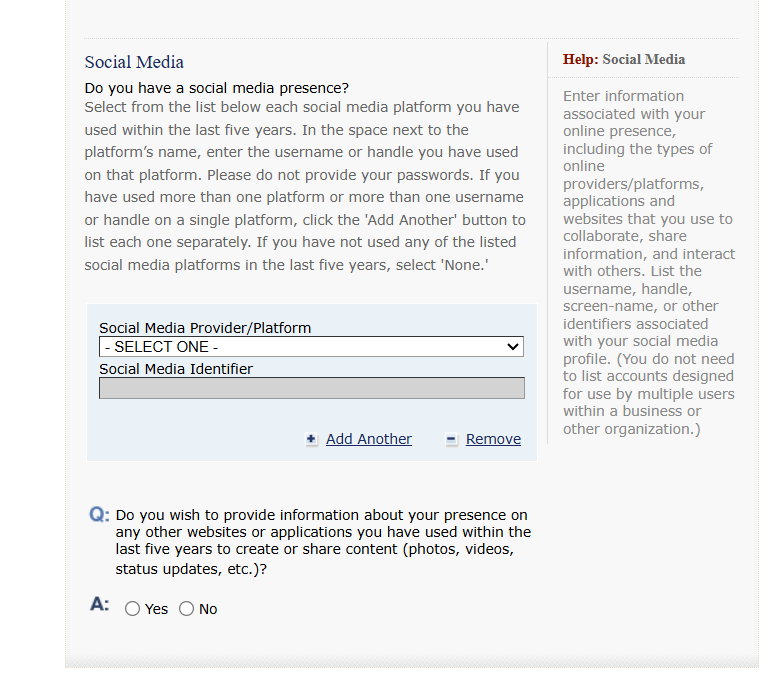
The dropdown social medial provider/platform list includes:
ASK FM, DOUBAN, FACEBOOK, FLICKR, GOOGLE+, INSTAGRAM, LINKEDIN, MYSPACE, QZONE (QQ), REDDIT, SINA WEIBO, TENCENT WEIBO, TUMBLR, TWITTER, TWOO, VINE, VKONTAKTE (VK), YOUKU, YOU TUBE
Recommendations:
We recommend that you are honest and forthcoming with providing all requested social media information.
Immigration and Customs Enforcement (ICE) activity
There have been recent developments and media coverage regarding immigration policies and enforcement. As a routine precaution while you are in the United States, we recommend carrying hard copies of key immigration documents, including:
- A valid, unexpired biographical passport page
- Your most recent I-94 arrival/departure record
- F-1 students: Form I-20 with a valid travel signature (6 months validity for students on OPT/STEM OPT; 12 months validity for all others)
- J-1 exchange visitors: Form DS-2019 with a valid travel signature (6 months validity for short-term scholars; 12 months validity for all others)
- H-1B, TN, E-3, and O-1: Documents confirming your current immigration status (e.g., approval notice and related documentation)
Keeping these documents readily available can help address questions quickly and reduce the risk of unnecessary delays or complications.
United States Citizenship and Immigration Services (USCIS) actions
USCIS Expectations for Complete Applications
Effective August 5, 2026, USCIS updated its policy on Requests for Evidence (RFEs) and Notices of Intent to Deny (NOIDs). Under the revised guidance, USCIS officers have greater discretion to deny an immigration benefit application without first issuing an RFE or NOID if required initial evidence is missing or the application does not establish eligibility when filed. USCIS may still issue an RFE in some cases, but applicants should not rely on the opportunity to submit missing documents later.
The policy also allows USCIS to set RFE response deadlines shorter than 12 weeks and eliminates the additional 14 days previously provided for notices mailed outside the U.S. The changes apply immediately to applications pending or filed on or after August 5, 2026. Students, scholars, and departments should ensure all required documentation is included before submitting USCIS applications.
Hold on pending USCIS applications – updated Jun 12, 2026
UPDATE: On June 5, 2026, the U.S. District Court for the District of Rhode Island blocked four USCIS policies that had paused immigration benefit processing for people from 39 countries covered by the presidential travel ban. Final judgement was released on June 11. As a result, some affected cases, including employment authorization and green card applications, may now move forward. OISS will continue to monitor this issue. The government may appeal the ruling, and more guidance may be issued in the coming days or weeks.
On June 12, 2026, USCIS published the news release “Court Order on Hold Policies.” The release notes that USCIS “will follow [the Court order terms] pending possible further judicial review.”
On January 1, 2026, USCIS issued a Policy Memorandum (PDF) to “Hold and Review” all pending USCIS benefit applications filed by citizens of the 39 countries affected by the updated travel ban implemented January 1. Find more information about travel restrictions on our website.
This policy memo will impact processing of various immigration applications, including employment authorization, extensions, amendments, and change of status requests. It states that approved benefits will be re-reviewed for those from the 39 countries who entered the U.S. on or after January 20, 2021. Additional reviews for those who entered before this date may also be possible.
The memo identifies a 90 day timeline for USCIS to “prioritize a list for review, interview, and re-interview, and issue operational guidance.”
Contact your OISS adviser with questions if this policy change may impact you.
Policy Memorandum on Adjustment of Status
On May 21, 2026, USCIS issued a policy memorandum titled “Adjustment of Status is a Matter of Discretion and Administrative Grace, and an Extraordinary Relief that Permits Applicants to Dispense with the Ordinary Consular Visa Process.”
This policy memorandum reminds beneficiaries that USCIS officers review adjustment of status applications on a case-by-case basis to determine whether an applicant must instead complete the process through consular processing with the U.S. Department of State outside the United States. If you have a pending adjustment of status application, please contact your immigration attorney to assess the impact on your case and determine whether any action is needed.
Contact your OISS adviser if you have questions about finding an immigration attorney.
USCIS screening social media activity for antisemitism
A DHS news release on April 9, 2025, announced a new guidance, effective immediately, that the USCIS will begin considering social media activity of nonimmigrants deemed anti-Semitic as grounds for denying immigration benefits adjudicated through USCIS. This will affect “aliens applying for lawful permanent resident status, foreign students and aliens affiliated with educational institutions linked to anti-Semitic activity.” USCIS will consider “social media content that indicates an alien endorsing, espousing, promoting, or supporting anti-Semitic terrorism, anti-Semitic terrorist organizations, or other anti-Semitic activity as a negative factor in any USCIS discretionary analysis when adjudicating immigration benefit requests.”
Additional guidance:
OISS interprets this announcement and new vetting process to apply to CPT, OPT, STEM OPT, Change of Status, Extensions and other F and J immigration benefit requests.
Know your rights
Understanding your legal rights and responsibilities is essential when living in the U.S., especially as laws may differ from those in your home country.
Refer to the Know Your Rights section of the OISS website for information on WashU policies, maintaining and protecting your non-immigrant status, your rights and interactions with law enforcement in the U.S., and more.
Attend a webinar
OISS offers regular “Navigating U.S. Immigration Today” webinars in which our staff discuss the latest information on immigration policies and updates that may impact your immigration status. These sessions offer practical information and an opportunity to ask questions in a supportive environment.
Check the OISS Event Calendar for the next session!